The Subscription Economy: Why 85% Waste $394/Year on Unused Services
The subscription economy hit $3T, but 85% waste $394/year on unused subscriptions. Learn why it happens and how to track, manage, and cancel effectively.
85.7% of people have at least one unused subscription, wasting an average of $394 annually. Meanwhile, the subscription economy has ballooned to $3 trillion globally, with the average person juggling 8.2 subscriptions totaling $1,416 per year.
Here's the paradox: while 51.9% say subscriptions improve their quality of life, 62% report "subscription fatigue" - up 34% since 2020. Nearly half (49%) are planning to cancel at least one subscription within the next year.
The subscription model isn't inherently bad. For many services - streaming entertainment, SaaS tools with continuous updates, cloud storage - subscriptions make perfect sense. But somewhere between Netflix in 2007 and heated car seats in 2022, we crossed a line.

This guide explores the full picture: why businesses love subscriptions (there are legitimate reasons), why consumers are struggling (the asymmetry is real), and how to take back control without abandoning genuinely valuable services.
Understanding the Subscription Economy
The subscription economy represents the fundamental shift from ownership to access. Instead of paying once for a product, you pay regularly - weekly, monthly, or annually - for ongoing access to products or services.
This isn't new. Newspapers pioneered subscriptions in the 1830s. What changed everything was 2007, when Netflix launched streaming video-on-demand. Spotify followed in 2008-2011. By the 2010s, software companies like Adobe, Microsoft, and Salesforce shifted from perpetual licenses to Software-as-a-Service (SaaS).
Then came the expansion: retail (Dollar Shave Club), food (HelloFresh), fitness (Peloton), gaming (Xbox Game Pass), and even automotive features (BMW's $18/month heated seats).
The Market Today
The numbers are staggering:
- $3 trillion global valuation (2025)
- 435% total growth from 2012 to 2024
- Average 8.2 subscriptions per person
- Average annual spending: $1,416
But growth is slowing. Churn rates hit all-time highs in 2024, with streaming reaching 44% churn in Q4 2024. The "subscription everything" era is facing its first major correction.
Why Businesses Love Subscriptions
Before criticizing the model, understand why subscriptions exploded. There are legitimate business advantages.
Predictable Revenue & Higher Valuations
One-time sales are unpredictable. Subscriptions provide consistent income that enables strategic planning.
Adobe Creative Cloud shifted from $999 perpetual licenses to $9.99/month subscriptions in 2013. Results:
- Subscription revenue: $1.23 billion → $18.28 billion (2013-2023)
- Stock performance: +1,000%
- 26+ million subscribers
Valuation advantage: Subscription businesses get 6-7x revenue multiples vs 1-3x for traditional product businesses. Dollar Shave Club was acquired for $1 billion with just 3 million subscribers.
Retention Economics
Acquiring new customers costs 5-25x more than retaining existing ones. Subscriptions create recurring contact without continuous selling costs. A 1% improvement in retention generates 6.71% revenue increase - double the impact of improving acquisition.
The Consumer Reality: Why We're Struggling
The business advantages are real. So why are consumers overwhelmed? Because the benefits are asymmetric.
The Five Major Pain Points
1. Tracking Difficulty
74% of people say it's easy to forget about recurring charges. A C+R Research study found consumers estimate they spend $86/month but actually spend $219/month - a $133/month underestimation gap ($1,596/year).
- Only 2% use a single app to manage subscriptions
- 72% set all subscriptions to auto-pay
- Canadians believe they have 4 subscriptions but actually have closer to 8
2. Unused Subscriptions Epidemic
85.7% have at least one unused subscription, with an average 3.3 unused subscriptions per person.
Unused rates by category:
| Category | Unused Rate |
|---|---|
| Dating Apps | 62% |
| Fitness Apps | 60% |
| Food Delivery | 52% |
| Streaming | 17-26% |
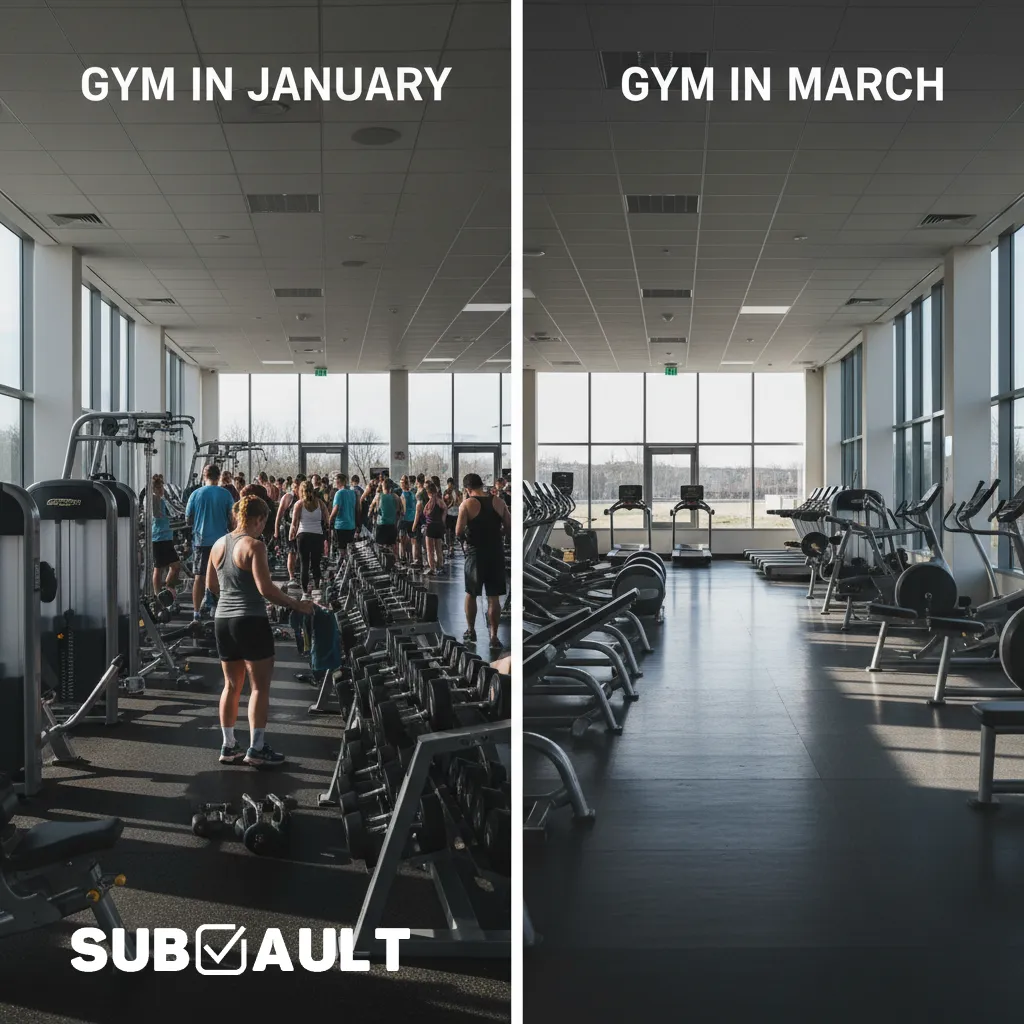
| Gym Memberships | 67% never utilized |
UK data: £688 million wasted annually on unused subscriptions (up from £306 million in 2022 - a £382 million increase in 2 years).
3. Surprise Charges & Auto-Renewals
64.8% forgot to cancel a free trial and got locked into paid subscriptions.
- 40% auto-renewed without their knowledge
- 39% forgot to cancel after free trial
- 24% thought they made a one-time purchase
4. Cancellation Dark Patterns
76% believe services make cancellation deliberately difficult.
"Dark patterns" are design choices that manipulate users. The "Roach Motel" pattern: easy to get in, difficult to get out.
Major cases:
- Amazon Prime: FTC sued for process requiring 4 pages, 6 clicks, 15 options
- Adobe: FTC complaint for hidden early termination fees
- Epic Games: $245 million fine for dark patterns in Fortnite
87.5% of major brands use guilt-inducing copywriting to prevent cancellations.
5. Rising Prices
60% would cancel their favorite service after a $5 price increase.
- 2/3 of subscribers report price increases
- Streaming spending increased 30%: $48 → $61/month (2023-2024)
- 49.7% said no price increase is acceptable
Take Control of Your Subscriptions
Track unlimited subscriptions for a one-time $29 payment. Get automated renewal reminders, spending analytics, and regain visibility into your recurring expenses.
Where Subscriptions Make Sense (And Where They Don't)
This isn't an anti-subscription manifesto. The problem is overapplication, not the model itself.
Where They Work
✅ SaaS tools with continuous updates (Adobe, Microsoft 365, Salesforce) - Ongoing development and infrastructure costs
✅ Streaming entertainment (Netflix, Spotify) - Content libraries continuously update, infrastructure costs are ongoing
✅ Cloud storage (Google Drive, Dropbox) - Server storage, bandwidth, security require continuous investment
✅ Services requiring infrastructure (Email hosting, VPNs, password managers) - The service only exists while infrastructure runs
Where They've Gone Too Far
❌ Physical products that used to be purchases - BMW's $18/month heated seats, HP Instant Ink subscriptions
❌ Features locked in purchased products - Car remote start at $25/month, features already installed but software-locked
❌ Subscription fatigue from oversaturation - Average 8.2 subscriptions creates overwhelming management burden
❌ Deliberately difficult cancellation - Phone calls during business hours, multiple confirmation pages, hidden cancel links
Taking Back Control
The average person wastes $394/year on unused subscriptions. The solution isn't abandoning all subscriptions - it's regaining awareness and control.
The Subscription Audit Framework
For a complete step-by-step walkthrough, see our detailed subscription audit guide.
Step 1: Gather All Subscriptions
- Check bank/credit card statements (past 3 months)
- Search email for "subscription," "renewal," "payment confirmation"
- Check app store subscriptions (Apple, Google Play, Amazon)
- Review streaming services, software licenses, memberships
Step 2: Calculate True Annual Spending
List every subscription with monthly cost, annual cost (monthly × 12), and billing date. This number is often shocking - remember, consumers underestimate by $133/month on average.
Step 3: Apply the Evaluation Tests
For each subscription:
- Usage Test: Used in past 30 days? Keep. Not used in 90+ days? Cancel.
- Value Test: "If I didn't have this today, would I subscribe again knowing what I know?"
- Replacement Test: "Is there a free alternative that meets 80% of my needs?"
- Budget Test: "Does this fit within my subscription budget?"
Prevention Strategies
Set Category Budget Limits
- Entertainment: $50/month (streaming, music, gaming)
- Productivity: $30/month (work tools)
- Fitness: $20/month
- Total example: $120/month ($1,440/year)
Use Virtual Cards for Free Trials
Services like Privacy.com or your bank's virtual card feature let you create cards with $1 limits. Even if you forget to cancel, the charge will decline.
Set Calendar Reminders
Add reminders 3 days before renewals when starting any subscription or trial. Takes 30 seconds at signup, prevents $50+ charges later.
Schedule Quarterly Reviews
Set recurring calendar reminder every 3 months to review all subscriptions, check for price increases, and cancel questionable ones. 15 minutes every quarter prevents hundreds in waste.
Management Solutions
Manual Tracking: Spreadsheets (Google Sheets, Excel), printable templates, budget apps (YNAB, Simplifi)
Dedicated Tools: SubVault provides automated renewal reminders and spending analytics for a one-time $29 payment - no recurring fee to track your subscriptions. For a full comparison of tracking tools, see our guide to subscription management apps.
Banking Integration: Some banks now surface recurring charges and let you set alerts.
The best system is the one you'll actually use consistently.
Stop Paying for Forgotten Subscriptions
SubVault helps you track unlimited subscriptions with automated renewal alerts and spending analytics. One-time $29 payment, no recurring fees, 30-day money-back guarantee.
The Future of Subscriptions
The "subscription everything" bubble is correcting, not collapsing.
Emerging trends:
- Hybrid models: Ad-supported tiers (Netflix, Disney+, Spotify)
- Pause options: 46% would stay for downgrade options - flexibility becomes differentiator
- Regulatory pressure: FTC "Click to Cancel" rule mandates easy cancellation
- Transparency advantage: 77% more likely to subscribe if cancellation is hassle-free
Subscriptions will remain dominant for SaaS with continuous updates, streaming entertainment, cloud services, and infrastructure products.
Subscriptions will retreat from physical products without ongoing service, features in already-purchased products, and services without continuous value delivery.
Winners will be companies that deliver genuine ongoing value, make cancellation easy, offer flexibility, and build trust through transparency.
The Bottom Line
The subscription economy reached $3 trillion by offering genuine benefits: convenience, access, continuous updates, and lower upfront costs. These advantages are real.
But scale created asymmetry. What's optimal for businesses (maximize retention, minimize churn) isn't always optimal for consumers (maintain only valuable subscriptions, cancel easily when value declines).
The numbers tell the story:
- 85.7% have unused subscriptions
- Average $394/year wasted
- $133/month spending underestimation gap
- 62% report subscription fatigue
- 76% believe companies make cancellation difficult
The problem isn't subscriptions - it's loss of control.
Netflix makes sense. Spotify makes sense. Adobe Creative Cloud makes sense. The problem is when you have 8.2 subscriptions, spend $1,416/year, underestimate your spending by $1,596/year, and can't easily see or manage what you're paying for.
Taking back control requires three things:
- Awareness: Know what you're subscribed to and what it costs annually
- Evaluation: Regularly assess whether each subscription delivers value
- Prevention: Build systems to avoid future subscription creep
This isn't about canceling everything. It's about conscious choice. Keep subscriptions that genuinely improve your life. Cancel the ones you forgot about. Set up systems to prevent future waste.
The average person wastes $394/year on unused subscriptions. The first step is awareness. The second is action. Start your audit today.
Ready to Take Control?
SubVault tracks unlimited subscriptions for a one-time $29 payment. Get automated renewal reminders, spending analytics, and never lose track again. 30-day money-back guarantee.
Last updated: October 13, 2025. All statistics verified from 2024-2025 studies and reports.
More from the SubVault blog
- How to Organize Your Subscriptions: A 6-Step System That Actually WorksStop wasting $264/year on forgotten subscriptions. Organize everything in one place with our 6-step system. Includes spreadsheet vs. app comparison.
- 6 Best Open Source Subscription Trackers (Self-Hosted Options)6 open source subscription trackers you can self-host. Compare Wallos, SubTrackr, Subs, and more - plus when a hosted option makes more sense.
- Free Subscription Tracker Google Sheets TemplateDownload our free Google Sheets subscription tracker. Track monthly/annual spending, renewal dates, and payment methods in one spreadsheet.
- How to Perform a Subscription Audit (Step-by-Step Guide + Real Savings)Learn how to perform a subscription audit in 30 minutes. Real examples, checklist, and proven strategies that saved people $500-1,800/year.
- How to Manage & Cancel Apple Subscriptions on iPhone, Mac & PCHow to find and cancel Apple subscriptions on iPhone (iOS 27), Mac, Windows, Apple TV and the web. Updated 2026 prices for Apple One, Apple TV, Music and iCloud+.
- Free Printable Subscription Tracker Templates (PDF Download)Download free printable subscription tracker templates to manage your subscriptions on paper. Nine professional PDF templates included - perfect for budgeting notebooks and planners.
- 7 Best Rocket Money Alternatives in 2026 (Free & Paid)Compare 7 Rocket Money alternatives for 2026: one-time payment, free and no-bank-link options, plus YNAB, Monarch, Copilot, Simplifi and PocketGuard pricing.